Good Evening Viewers,
As per the usual schedule, students began the day with their beloved Radio Taisō (which I assure that they will continue for the rest of their lives). Following a shortened language class in the morning, students returned to Andrews Hall and attended a series of cultural presentations and demonstrations on various topics including: soy sauce, traditional Japanese instruments, and Aikido. Lunch was provided by the San-J soy sauce company in the form of "onigirazu", rice and toppings wrapped in a sheet of dried seaweed, while the company members gave a presentation on the different kinds of soy sauce and their soy sauce production methods. Afterwards students enjoyed various renditions of traditional Japanese music played on the koto, the shakuhachi (Japanese Flute), and the taiko by guest lecturer, Hwang-sensei. Finally, students learned Aikido from Randolph Macon's own Sheldon-sensei. Recurring quotable-person Parish-san, said, "He taught me that I am an octagon, but now I know that I need to be a circle. And a square. And a triangle.". After the dinner which I promise your children ate, though the majority of the time was spent trying to convince the next guest lecturers to eat plate-fulls of ice cream mixed with various dessert items found in the cafeteria, the students absorbed a presentation by guest speaker, Lawless-sensei, on Japanese hip-hop and afterwards "rapped" (I use the term loosely to describe making funny sounds with their mouths into recorders), guided only by the lyrics to several popular hip-hop songs. Your students are alive, educated, and well fed, the last of which I can confirm based on the fact that the blog company is currently eating rice mixed with mayonaise and bonito flakes.
This has been your Thursday evening news,
Joseph-san
Showing posts with label Taiko. Show all posts
Showing posts with label Taiko. Show all posts
Thursday, July 9, 2015

Wednesday, July 8, 2015
7 July 2015: Tanabata Matsuri


A student-led group organized and planned the festival's activities which included bottle fishing, Menko, ring toss, and many others. In addition, students put on a play depicting the traditional Tanabata legend of Orihime and Hikiboshi, a couple that was separated and only permitted to meet once a year on July 7th. After that, students enjoyed a live Taiko drum performance by River City Taiko, a local Taiko group that the academy's own Uchisawa Sensei has been a long-standing member of. The whole academy enjoyed the event: "It was absolutely splendid," said Rahi, an academy student.
The Tanabata festival was a relaxing, and fun way to conclude the day.
-Conner San
Tuesday, July 8, 2014
7 July 2014: The Star Festival~!
 |
| Rivercity Taiko Group performing for the GJA Students |
Today we celebrated the annual Japanese summer festival of
Tanabata, held every year on June 7th (7/7). There’s a legend behind
the festival where two lovers, Orihime and Hikoboshi, get separated by the
gods. Only on June 7th can they see each other again, and the
Japanese celebrate their reunion on this day. The festivities usually consist
of yukata (summer kimono), bon odori (dancing in a circle), games, lots of food,
and fun activities for all. We also had the opportunity to watch a performance
from River City Taiko, a taiko drumming group from Richmond. Everyone enjoyed
the performance thoroughly! Afterwards, we sang the traditional Tanabata song
as a group, and witnessed a short skit from the Tanabata company. It is also a
Tanabata tradition to write down your wish on the tanzaku (wish paper) and hang
it on the sasa (type of bamboo tree). Then we proceeded to the games, prizes,
and fun. All of the sensei declared this festive event the highlight of the
academy!
-Amy
 |
| Lindsey and Suyun playing on taiko drums, performing the skills they've learned in taiko culture class |
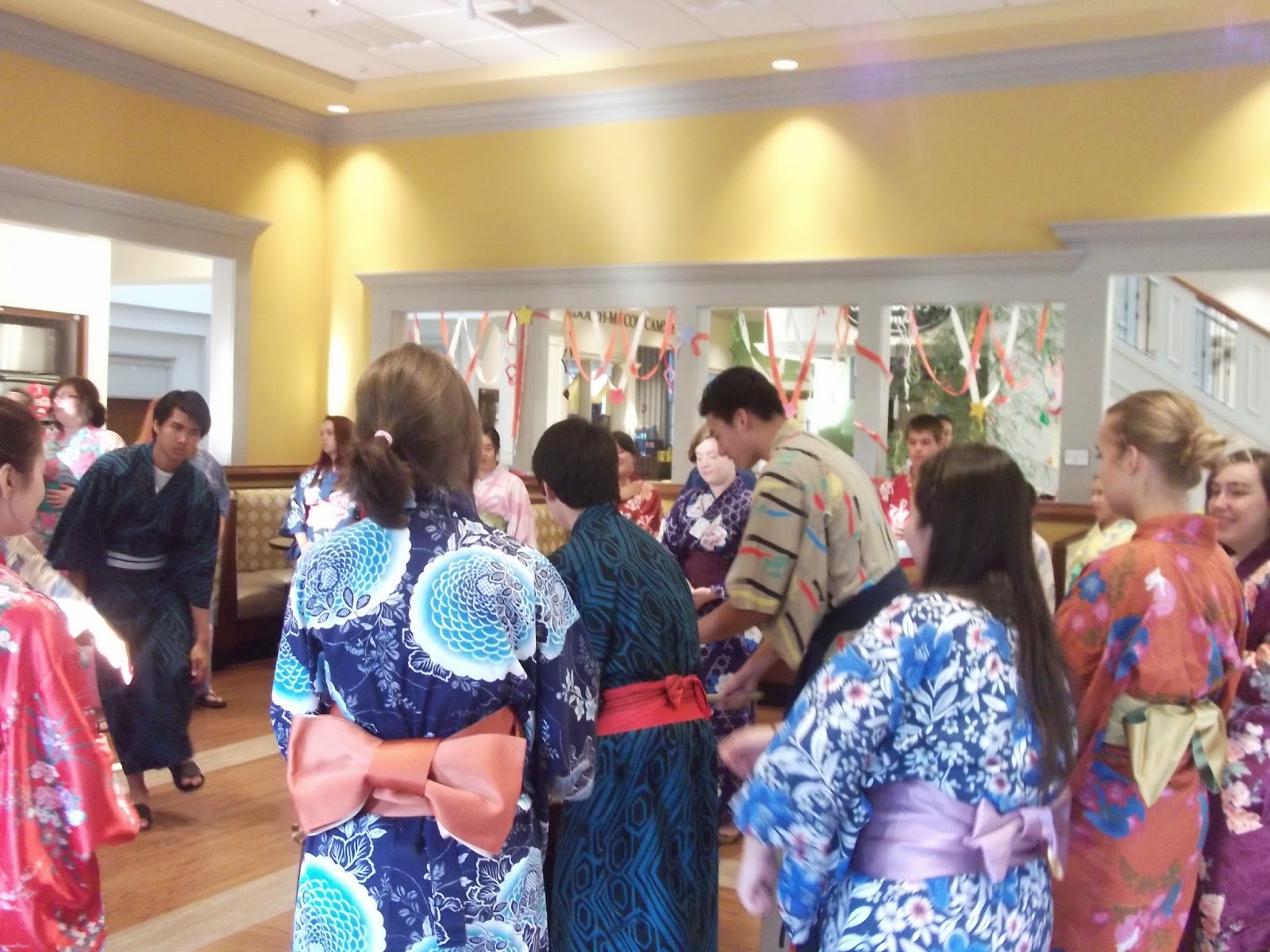 |
| GJA Students wearing yukata, summer clothing and playing the taiko drums together |
Monday, July 7, 2014
5 July 2014: Japanese Movie Night
7/5
Saturday evening we had the chance to watch the Japanese comedy, The Magic Hour. This followed the story of a young man under the employment to the town’s boss and his attempts to save his life and his girlfriend. When the boss demands to see the hit man, Della Togashi, the young man hires an amateur actor, who believes he is acting the role in a movie. Of course hilarity ensues as the young man pretends to be a director and lets no one know the reality of the situation.
-Melissa
Word of the day: Kazoku (family)
Yahhou! やっほー
Yesterday the student’s in Otani sensei’s culture class were
treated to another extravagant lesson in the art of the taiko drum. Otani
sensei and Tomomatsu senpai taught students synchronization via repetition and
utilized metronomes to instill that sense of togetherness amongst the students.
Taiko drummers mutter short “battle cries” to communicate what move is being
performed which include:
Don + Kon – Heavy hit
Su – Pause
Tsu- Light hit
The students utilized these simplistic motions to create an
extended pattern of taiko drumming and rumor has it that a performance may be
scheduled for the closing ceremony (spoiler alert).
- Antoine
Saturday evening we had the chance to watch the Japanese comedy, The Magic Hour. This followed the story of a young man under the employment to the town’s boss and his attempts to save his life and his girlfriend. When the boss demands to see the hit man, Della Togashi, the young man hires an amateur actor, who believes he is acting the role in a movie. Of course hilarity ensues as the young man pretends to be a director and lets no one know the reality of the situation.
-Melissa
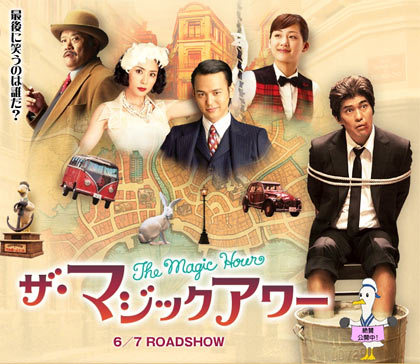 |
| Japanese Movie: The Magic Hour |
Friday, June 27, 2014
27 June 2014: Cooking Japanese Cuisine
6/27
Today’s word is ryōri, meaning cooking or cuisine. It can also be made into a verb, “to cook,” with the addition of suru.
Today’s word is ryōri, meaning cooking or cuisine. It can also be made into a verb, “to cook,” with the addition of suru.
Today, we participated in our daily Japanese exercise routine, rajio taisou. Rajio taisou is an aerobic exercise which focuses on a full range of mobility of the body, from someone’s arms to his torso and finally to his legs. Rajio taisou helps loosen up muscles and relieves tension throughout the body by combining stretching with consistent movement. Consisting of about ten steps, rajio taisou begins with simple arm flails and gradually evolves into downward stretches as well as side shuffles and jumping in place to get the blood pumping. Also, today we, the oh so wonderful students of the academy, led the exercise ourselves without a senpai or sensei leading us in order to learn the process by memory instead of simply mimicking another’s movements
- Antoine
 |
| Katherine making an obi in Otani-sensei's culture class |
Today, we cooked our own dinner of onigiri (rice balls) and gyoza
(dumplings). The advanced Japanese class aided us with visual descriptions of
how to make onigiri and gyoza. For the onigiri, we wrapped some rice in saran
wrap, shaped the rice ball, added seasoning and enjoyed! The gyoza was a little
more complex. We added various ingredients to a bowl of meat, stuffed the mix
into a dumpling, and fried them. There was also the option to put tofu into the
gyoza, instead of meat, for vegetarians. The food was all so much more
delicious with the knowledge that we had made it ourselves!
- Amy
 |
| Suyun (L) , Sara (M) and Javan (R) explaining to the GJA students in Japanese how to make onigiri (riceballs) |
 |
| Amy and Camilla making the filling for gyoza (dumplings) |
Tomomatsu Senpai’s Taiko Class
Today in the culture classes, one of our groups learned the history of
Japanese taiko drumming from Tomomatsu Senpai. When taiko drumming, the
drummers do not use sheet music. Instead, the notes are represented by certain
sounds: “don”, for the loud drum sound, “ka”, for the rim sound, “ten”, for the
sound emitted by a shime-daiko, or small taiko, and “tsu,” for a light tap.
Tomomatsu Senpai had each of us play a few notes on the taiko. Many students
were surprisingly strong, and the students who enjoyed it will be playing the
taiko on a team with Ōtani Sensei.
- Christina B.
- Christina B.
 |
| Tomomatsu-senpai teaching Antoine how to play the Taiko |
 |
| Tomomatsu-senpai teaching Erik how to play the Taiko |
Tuesday, June 24, 2014
24 June 2014: Recap of Day 2 & 3
6/23 (Day 2 Recap)
Word of the day: Nihongo
(Japanese language)
Yesterday was the start of our three week Japanese language
and culture journey. In the beginner’s class, students learned about the
Japanese language, encompassing vocabulary and hiragana,
one of three Japanese writing styles. Uchida sensei taught the beginners basic
greetings to provide the students with the ability to strike up a conversation
in nihongo (Japanese). In addition to
expanding students’ knowledge of vocabulary of nihongo, students practiced the formation and stroke order of
hiragana. Afterwards, students were treated with an authentic peer-to-peer nihongo experience, pitting beginning,
intermediate, and advanced students in an all-nihongo lunch where for one hour students were only allowed to
speak nihongo where many less-experienced students
reiterated the phrase “nani desuka?” (“what is that?”). This allowed beginning
students to utilize their newfound knowledge while higher-level students aided
in any language mishaps along the way. After lunch, students were treated to a
one-hour film class, which featured he film Princess Mononoke, held by one of
the campus’ professors in which the students learned about nihongo animation, specifically Miyazaki films, and how he
encompassed elements of modern themes and utilized the Japan’s vast history.
Afterwards, students were lectured on campus safety by the assistant director
of campus safety, Mr. Daugherty, on the campus in which students learned about
the many safety features located throughout the campus. Following campus safety,
students were allowed two hours of recreation time within the campus’s gymnasium,
enjoying a plethora of equipment such as a pool, racquetball courts, and
basketball courts, as well as a fitness center and others facilities. After cleaning
up, students were treated to dinner and then attended their first of many
culture classes hosted by their senpai. Kim-senpai taught one group about the
differences and similarities between Japanese and Western animations, which
included how audiences’ perception of each animation style varies from country
to country. Chung-senpai educated students on the evolution of Japanese pop
music and culture in Japan. Tomomatsu-senpai displayed the art of Taiko
drumming to her students and showed them the techniques required to play the
drums. Rounding off the day, students elected company leaders to perform
various activities around campus throughout the duration of the academy and the
company leaders recruited students to assist them on their tasks. After a
fun-filled day of various activities, students recorded their experiences in
their journals for the purpose of reminiscing at the academy’s end.
- Antoine and Melissa
6/24 (Day 3)
Today, the beginner-level students continued to learn
hiragana, one of the three Japanese writing styles. Uchida Sensei revealed many
tips and tricks to facilitate memorization. The students have only had three
days of exposure to the language, but are continuously learning new symbols and
phrases. The students participate in group learning to mimic the Japanese
group-mentality. After reviewing the hiragana symbols, Uchida Sensei passed out
a blank board game and asked the students to fill in the spaces with the new
symbols they had learned. This game required quick recollection and encouraged
students to memorize the hiragana characters. This creative activity was an
enjoyable and effective method! At the end of language class, the students all
introduced themselves to each other and conversed completely in Japanese. This
is a huge accomplishment considering the minimal experience these students
have. So much progress is being made, and this is only the beginning!
Today, Lawless Sensei taught the advanced class in the
afternoon (We normally have Ōtani Sensei ). Lawless Sensei started off the
class by having the advanced students play Taboo in Japanese. The students did
well, but having a smaller vocabulary makes the game a lot harder. In
preparation for Friday’s cooking class, in which everyone will make gyoza
(dumplings) and onigiri (rice balls), Lawless Sensei helped the students
re-learn cooking vocabulary. The advanced students will be asked to explain the
recipe to the beginning students in Japanese. The Taboo game was a way to
prepare the advanced students to explain unknown words using circumlocution.
Finally, the advanced students read a story about an exchange student in Japan
who ate her meal with gusto until she realized the meat was suppon, or snapping turtle!
- Christina B.
Today for our guest speaker we had Kristen Luck, a Ph. D candidate at
VCU, come and give us a lecture. It was about Japanese politics. She analyzes
documents and labor laws in Japan and searches for keywords referring to woman’s
rights, specifically laws referring to the objectification of women’s bodies
for childbirth and child rearing. We also watched a PowerPoint explaining the
governmental and political system in Japan. She explained that the Edo and
Meiji periods of Japan were a time where the emperor was revered. Afterwards,
she explained how Japan’s political system had changed so drastically from
imperialism to capitalism. Today, instead of an emperor executing all major
actions for the country of Japan, there is now a parliamentary system in place
similar to England. This is because of the occupation of Japan by the United
States, where the United States wrote a constitution for the previously
imperial country. The emperor is now currently a figurehead, and now the Prime
Minister carries out most executive duties (sort of like a president). She also
touched upon the issue of discrimination in Japan, mostly directed towards
people of a race other than Japanese and Japanese women, her specialty. There
was a question-and-answer session afterwards, where we asked questions and had
a discussion.
-Amy
Subscribe to:
Posts (Atom)